
Brihadeeswara Temple, Thanjavur: History, Architecture & Mysteries
Scooplist | History & Culture
The Brihadeeswara Temple in Thanjavur, also known as the Big Temple or Peruvudaiyar Kovil, is one of India’s greatest architectural masterpieces.
Built by Rajaraja Chola I and consecrated in 1010 CE, this magnificent Shiva temple represents the engineering brilliance, artistic excellence and cultural legacy of the Chola Empire.
Famous for its towering granite vimana, massive Nandi statue, ancient inscriptions and extraordinary stone carvings, the temple is part of the UNESCO-listed Great Living Chola Temples.
Here’s everything you need to know about its history, construction, fascinating legends, architecture and visiting information.
Brihadeeswara Temple: Key Facts
| Detail | Information |
|---|---|
| Location | Thanjavur, Tamil Nadu |
| Main deity | Lord Shiva |
| Built by | Rajaraja Chola I |
| Consecrated | 1010 CE |
| Original name | Rajarajeshvaram |
| Architecture | Dravidian / Chola |
| Vimana height | Approximately 60–66 metres |
| UNESCO status | World Heritage Site since 1987 |
| Entry fee | Free |
| Best time to visit | October–February |
History of Brihadeeswara Temple
The Brihadeeswara Temple was commissioned by Rajaraja Chola I, one of South India’s most influential emperors, who ruled from 985 CE to 1014 CE.
During his reign, the Chola Empire expanded its political and maritime influence across southern India and neighbouring regions.
Construction of the temple began around 1003–1004 CE and was completed around 1009–1010 CE.
Originally named Rajarajeshvaram, the temple was dedicated to Lord Shiva and symbolised both the emperor’s devotion and the power of the Chola kingdom.
Its design also reflected the sacred concept of Dakshina Meru, associating the towering shrine with Mount Meru, the cosmic mountain of Hindu tradition.
More than a place of worship, the temple became an important centre of religious activity, administration, art, music and cultural life.
The Architectural Marvel of Brihadeeswara Temple
Brihadeeswara Temple is among the finest surviving examples of Chola-period Dravidian architecture.
Its monumental proportions, precisely worked granite and detailed sculptures demonstrate the exceptional craftsmanship of 11th-century builders.
1. The Towering Vimana
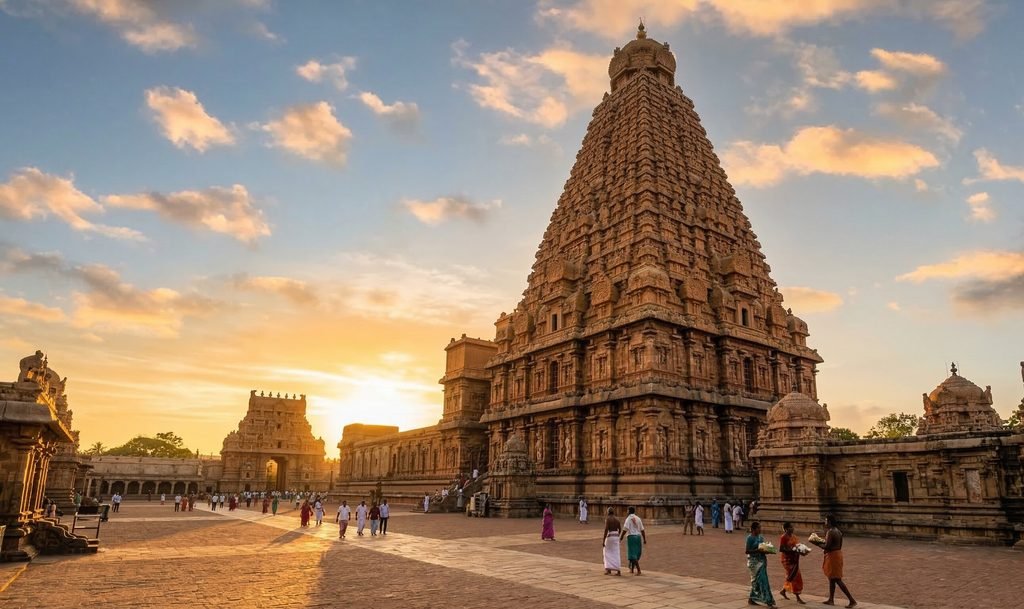
The temple’s most recognisable feature is its magnificent vimana, the pyramidal tower rising above the sanctum.
Standing approximately 60–66 metres high, depending on the measurement used, it consists of thirteen diminishing architectural tiers crowned by an octagonal structure.
Unlike many later South Indian temple complexes where entrance gopurams dominate the skyline, Brihadeeswara’s central shrine tower rises prominently above its gateways.
This distinctive composition became a defining achievement of Chola architecture.
2. The Famous 80-Tonne Capstone
One of the temple’s greatest engineering questions concerns the massive stone structure crowning the vimana.
Popular accounts describe an approximately 80-tonne stone cap, although its precise weight and construction details remain debated.
A widely repeated theory suggests that workers used a long earthen ramp, possibly extending several kilometres, to transport heavy stone blocks to the upper levels.
However, no definitive archaeological evidence establishes the exact method.
The remarkable achievement lies in how Chola builders constructed such a massive, carefully proportioned stone tower using the technology available during the 11th century.
3. The Giant Nandi Statue
Facing the main Shiva shrine stands an enormous monolithic sculpture of Nandi, Lord Shiva’s sacred bull.
Carved from a single block of stone, it is among Tamil Nadu’s most impressive Nandi sculptures.
The pavilion surrounding it reflects later architectural contributions, particularly from the Nayaka period.
4. The Sacred Shiva Lingam
The inner sanctum houses a massive Shiva Lingam, worshipped as Brihadeeswarar.
The temple remains an active centre of Shaiva worship, where traditional pujas, abhishekams and religious festivals continue.
5. Magnificent Sculptures and Pillars
The temple complex features intricately carved deities, guardian figures, ceremonial halls and historic corridors.
Particularly significant are the sculptural representations of Shiva and the carvings depicting 81 of the 108 karanas, or classical dance movements described in the Natya Shastra.
These carvings connect the temple’s artistic legacy with India’s ancient performing arts traditions.
The Chola Inscriptions: A Thousand-Year-Old Historical Record
One of Brihadeeswara Temple’s most remarkable features is its extensive collection of inscriptions.
These records document royal donations, temple administration, religious practices, land grants and the responsibilities of people employed by the temple.
They also describe musicians, dancers, priests, artisans and other workers who supported its daily functioning.
The inscriptions offer valuable insight into the sophisticated administrative and cultural organisation of the Chola Empire.
Unlike many historic monuments, Brihadeeswara preserves not only extraordinary architecture but also detailed written evidence of the society that built and maintained it.
Ancient Chola Murals and Paintings
The temple contains important surviving examples of 11th-century Chola mural paintings.
Located in passages around the sanctum, these paintings depict Lord Shiva, religious narratives, saints and scenes associated with royal patronage.
During the Nayaka period, additional paintings were created over portions of the earlier Chola artwork.
The older murals were rediscovered in the 20th century and are now recognised as significant examples of medieval South Indian painting.
These murals are historically valuable, although they are not older than the famous ancient paintings at Ajanta.
Brihadeeswara Temple Mysteries: Myths vs Facts
Several fascinating stories surround the construction of the Big Temple.
Does Brihadeeswara Temple Really Have No Shadow?
A popular legend claims that the temple’s towering vimana never casts a shadow on the ground.
This is scientifically incorrect.
Like any physical structure, the tower casts a shadow when illuminated by sunlight.
Its shadow changes throughout the day and may appear unusually short when the Sun is high overhead.
The temple’s impressive geometry is a genuine architectural achievement, but the claim of a permanently shadowless tower is a myth.
How Was the Massive Capstone Lifted?
The exact technique used to raise the heavy upper stone components remains uncertain.
Earthen ramps, scaffolding, ropes, rollers and coordinated labour are among the methods discussed by architectural researchers and historians.
The frequently mentioned six-kilometre ramp should be understood as a theory rather than a proven historical construction record.
Was the Temple Built Without Mortar?
Brihadeeswara Temple is celebrated for its precisely fitted stone construction.
Its massive granite blocks demonstrate sophisticated engineering and knowledge of structural stability.
However, claiming that every component of the temple complex was built entirely without mortar oversimplifies a monument that contains structures and additions from several historical periods.
Brihadeeswara Temple and the Great Living Chola Temples
Brihadeeswara Temple is one of three monuments included in UNESCO’s Great Living Chola Temples World Heritage property.
| Temple | Location | Built By |
|---|---|---|
| Brihadeeswara Temple | Thanjavur | Rajaraja Chola I |
| Brihadisvara Temple | Gangaikondacholapuram | Rajendra Chola I |
| Airavatesvara Temple | Darasuram | Rajaraja Chola II |
Thanjavur’s Brihadeeswara Temple received UNESCO World Heritage recognition in 1987.
In 2004, the designation was extended to include the temples at Gangaikondacholapuram and Darasuram.
Together, these monuments represent the evolution of Chola architecture, sculpture and religious traditions.
Brihadeeswara Temple Timings, Entry Fee and Visitor Guide
Temple Timings
| Session | Timings |
|---|---|
| Morning darshan | 6:00 AM–12:30 PM |
| Evening darshan | 4:00 PM–8:30 PM |
| General entry fee | Free |
| Recommended visit | 1.5–3 hours |
Timings may change during festivals and special rituals.
Best Time to Visit
October to February offers comparatively pleasant weather for exploring Thanjavur.
Early mornings provide comfortable temperatures and beautiful lighting for architecture photography.
Evenings are ideal for experiencing the temple’s devotional atmosphere.
Essential Visitor Tips
- Wear modest clothing suitable for temple worship.
- Remove footwear before entering designated temple areas.
- Respect restrictions on photography inside the sanctum and protected mural spaces.
- Carry drinking water, especially during summer.
- Allow additional time during Maha Shivaratri and major festivals.
- Consider a qualified heritage guide to better understand the inscriptions and architecture.
Nearby Places to Visit in Thanjavur
Combine your temple visit with these important heritage destinations.
Thanjavur Maratha Palace: A historic royal complex featuring architectural remains, art collections and cultural heritage.
Saraswathi Mahal Library: One of India’s most historically significant libraries, known for its rare manuscripts and literary collections.
Gangaikondacholapuram Temple: Another UNESCO-listed Chola masterpiece, associated with Rajendra Chola I.
Airavatesvara Temple, Darasuram: A remarkable Chola temple renowned for its elaborate sculptures and chariot-shaped mandapa.
Frequently Asked Questions
Who built Brihadeeswara Temple?
Brihadeeswara Temple was commissioned by Chola emperor Rajaraja Chola I and consecrated around 1010 CE.
How old is Brihadeeswara Temple?
The temple is more than 1,000 years old, having been completed in the early 11th century.
Is Brihadeeswara Temple a UNESCO World Heritage Site?
Yes. It was inscribed in 1987 and is part of the Great Living Chola Temples UNESCO World Heritage property.
Is the Brihadeeswara Temple shadow mystery true?
No. The temple casts a shadow like other buildings. The popular claim that its tower never casts a shadow is a myth.
What is special about Brihadeeswara Temple?
Its towering granite vimana, monumental architecture, ancient inscriptions, Chola murals, enormous Nandi statue and continuing religious traditions make it exceptional.
Is entry to Brihadeeswara Temple free?
Yes. General entry is free, although separate arrangements or restrictions may apply to specialised visits and protected areas.
Conclusion
The Brihadeeswara Temple in Thanjavur stands as an extraordinary example of India’s architectural, artistic and spiritual heritage.
Built over a thousand years ago under Rajaraja Chola I, its magnificent vimana, intricate sculptures, ancient murals and detailed inscriptions continue to reveal the brilliance of Chola civilisation.
Beyond its engineering achievements and popular mysteries, Brihadeeswara remains a living temple where history and devotion come together.
For history enthusiasts, architecture lovers and spiritual travellers, the Thanjavur Big Temple is one of South India’s most remarkable heritage destinations.
Have you visited the Brihadeeswara Temple? Share your experience in the comments!
Explore more stories about Indian temples, architecture, history and cultural heritage on Scooplist.
Sources and References
- UNESCO – Great Living Chola Temples – Official heritage documentation, architecture and history.
- UNESCO – World Heritage Extension Decision, 2004 – Addition of Gangaikondacholapuram and Darasuram.
- Incredible India – Brihadeeswarar Temple – Visitor information and architectural highlights.
- Ministry of Culture – Great Living Chola Temples – Government heritage overview.
- P. S. Sriraman, Chola Murals: Documentation and Study of the Chola Murals of Brihadisvara Temple, Thanjavur, Archaeological Survey of India, 2011.
Editorial note: Historical facts are distinguished from popular legends and unverified engineering theories. Visitor timings and access arrangements may change.