

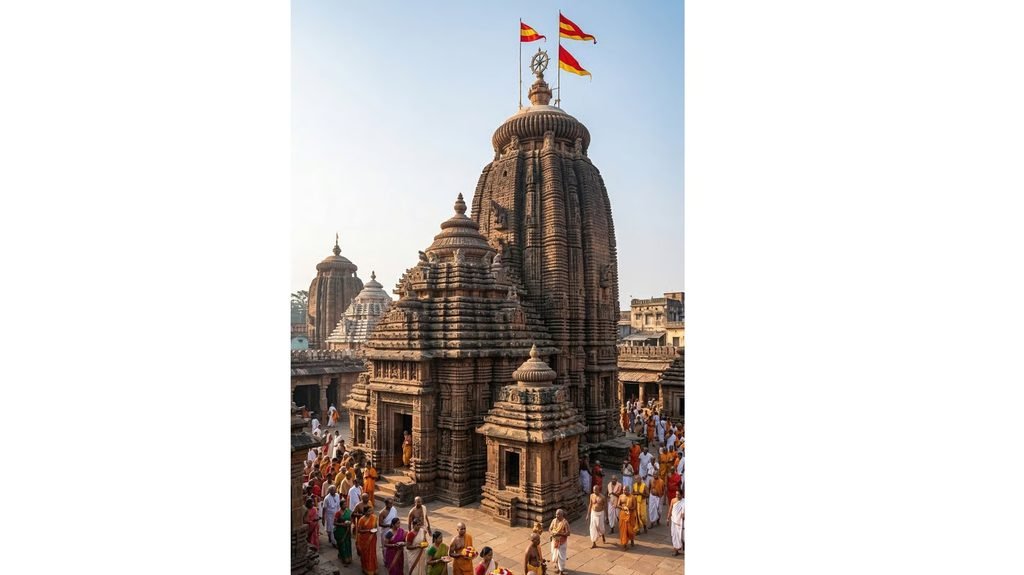
Jagannath Temple Puri: History, Mysteries, Rath Yatra & Sacred Traditions
The Shree Jagannath Temple in Puri, Odisha, is one of India’s most revered Hindu pilgrimage destinations and an important part of the Char Dham tradition.
Dedicated to Lord Jagannath, a form of Lord Vishnu associated with Krishna, the temple is famous for its distinctive wooden deities, magnificent Kalinga architecture, ancient rituals and world-renowned Rath Yatra.
But what makes Jagannath Temple truly extraordinary is the fascinating story behind its unusual deities and the centuries-old traditions that continue today.
Jagannath Temple Puri: Key Facts
| Detail | Information |
|---|---|
| Location | Puri, Odisha |
| Main deities | Jagannath, Balabhadra and Subhadra |
| Historical construction | 12th century CE |
| Principal royal patron | Anantavarman Chodaganga Deva |
| Architecture | Kalinga / Rekha Deula |
| Main temple height | Approximately 65 metres |
| Religious importance | One of Hinduism’s four Char Dhams |
| Famous festival | Rath Yatra |
| Entry fee | Free |
| Best visiting season | October–March |
History of Jagannath Temple, Puri
The present Jagannath Temple was constructed during the 12th century under the Eastern Ganga dynasty.
King Anantavarman Chodaganga Deva is widely credited with initiating its construction, while subsequent rulers contributed to its completion and development.
The temple became a major centre of Vaishnava devotion and an important symbol of Odisha’s religious and cultural identity.
Over the centuries, its traditions were influenced by several devotional movements, including those associated with Adi Shankaracharya, Ramanuja and Chaitanya Mahaprabhu.
The temple also preserves connections with regional tribal traditions, making Jagannath worship a distinctive combination of classical Hindu theology and local cultural heritage.
The Sacred Origin Story of Lord Jagannath
According to the Skanda Purana and regional Jagannath traditions, King Indradyumna was a devoted worshipper of Lord Vishnu who wished to establish a magnificent temple.
The legend tells of a sacred manifestation known as Nila Madhava and the king’s search for the divine presence.
Following divine instructions, the king discovered a sacred wooden log floating in the sea.
A mysterious elderly carpenter, traditionally identified with Vishwakarma, agreed to carve the deities on one condition: he must not be disturbed until the work was complete.
When the chamber was opened prematurely, the carpenter disappeared.
Inside stood the distinctive wooden forms of Jagannath, Balabhadra and Subhadra, with large circular eyes and simplified limbs.
According to the devotional tradition, these forms were accepted as the Lord’s chosen appearance.
This story explains one of the most recognisable features of Jagannath worship.
Why Does Lord Jagannath Have No Fully Formed Hands or Feet?
Unlike conventional Hindu deity sculptures, Lord Jagannath is depicted with enormous eyes, a broad face and simplified limbs.
His brother Balabhadra and sister Subhadra are represented in similarly distinctive wooden forms.
Within devotional interpretations, these unusual features symbolise the divine presence beyond ordinary human limitations.
The large eyes are commonly understood as representing the Lord’s all-embracing vision, while the simplified form expresses the infinite nature of divinity.
Different Vaishnava traditions offer their own philosophical explanations, including interpretations connected with Lord Krishna’s divine love and spiritual ecstasy.
Rather than an incomplete sculpture, devotees recognise Jagannath’s form as sacred and complete in its own unique way.
Jagannath Temple Architecture: The Glory of Kalinga Style
Jagannath Temple is an outstanding example of Odisha’s traditional Kalinga architecture.
Its approximately 65-metre-high central tower features a distinctive curvilinear structure known as a Rekha Deula.
The temple complex includes four principal architectural sections:
- Vimana: The main sanctum housing the deities.
- Jagamohana: The assembly hall.
- Nata Mandira: The ceremonial hall associated with devotional performances.
- Bhoga Mandapa: The hall associated with sacred food offerings.
The temple has four major gateways, each named after a sacred animal: the Lion Gate, Elephant Gate, Horse Gate and Tiger Gate.
The eastern Singhadwara, or Lion Gate, is the principal entrance.
Atop the main tower sits the Nila Chakra, an eight-spoked wheel made from a traditional metal alloy, and the sacred flag that is ceremonially changed every day.
Famous Mysteries of Jagannath Temple: Myths and Facts
Jagannath Temple is surrounded by popular stories about its extraordinary architecture and rituals.
1. Does Jagannath Temple Cast No Shadow?
A popular claim suggests that the temple never casts a shadow.
Fact: The tower casts shadows according to the position of the Sun. The claim that it never produces a shadow is not scientifically supported.
2. Does the Temple Flag Always Fly Against the Wind?
The flag atop the temple sometimes appears to move differently from the wind experienced at ground level.
Air currents around tall structures can change direction due to turbulence and pressure differences.
There is no reliable evidence that the flag always flies against the actual wind at its height.
3. Why Does the Nila Chakra Appear to Face Everyone?
The Nila Chakra is designed as a symmetrical wheel.
Its appearance from different viewing angles has inspired devotional interpretations, but it does not require an unexplained violation of optical principles.
4. Does Food in the Topmost Pot Cook First?
The temple’s traditional kitchen uses earthen pots arranged in stacks over wood-fired stoves.
Stories suggest that food in the uppermost pot cooks first, but this claim has not been established through reliable scientific testing.
The cooking tradition itself remains a remarkable part of Odisha’s living culinary heritage.
Nabakalebara: The Sacred Renewal of Wooden Deities
One of Jagannath Temple’s most distinctive traditions is Nabakalebara, meaning new body.
During this elaborate ritual, the wooden forms of Jagannath, Balabhadra, Subhadra and Sudarshana are replaced with newly carved sacred figures.
The ceremony takes place in special years of the Hindu lunisolar calendar, generally at intervals of 12–19 years.
Specially designated servitors identify suitable neem trees and supervise the sacred carving process.
According to temple belief, the divine essence associated with the deities is ceremonially transferred into the new wooden forms.
The previous figures are then respectfully interred within the temple’s sacred grounds.
The most recent Nabakalebara was performed in 2015.
This tradition symbolises renewal, continuity and the distinction between the physical form and the eternal divine presence.
Rath Yatra: The World-Famous Chariot Festival
The annual Puri Rath Yatra is among India’s largest and most celebrated religious festivals.
During the festival, Lord Jagannath, Balabhadra and Subhadra are ceremonially brought out of the main temple and placed on three enormous wooden chariots.
Devotees pull the chariots along Puri’s Grand Road to the Gundicha Temple, approximately three kilometres away.
The Three Sacred Chariots
| Deity | Chariot | Number of Wheels |
|---|---|---|
| Lord Jagannath | Nandighosa | 16 |
| Lord Balabhadra | Taladhwaja | 14 |
| Goddess Subhadra | Darpadalana | 12 |
The chariots are constructed afresh every year using traditional craftsmanship and prescribed materials.
After their stay at Gundicha Temple, the deities return to the main shrine in the Bahuda Yatra procession.
Rath Yatra is especially significant because it allows people of different backgrounds to participate in the public celebration of Lord Jagannath.
The English word juggernaut also developed from the name Jagannath through historical accounts of the enormous temple chariots.
Mahaprasad and the Famous Jagannath Temple Kitchen
Jagannath Temple is renowned for its sacred food offerings, particularly the tradition of Chhappan Bhog, associated with 56 varieties of food offered to the Lord.
The temple kitchen uses earthen pots and traditional wood-fired cooking methods.
After being offered according to temple rituals, the sacred food becomes Mahaprasad.
It is distributed through the temple’s Ananda Bazaar and holds deep religious and cultural significance for devotees.
The practice reflects the importance of food, service and shared devotion within Jagannath traditions.
Major Festivals at Jagannath Temple
Beyond Rath Yatra, the temple observes several important annual festivals.
| Festival | Significance |
|---|---|
| Chandan Yatra | Ceremonial sandalwood rituals and boat processions |
| Snana Yatra | Sacred bathing ceremony of the deities |
| Anavasara | Period when the deities are withdrawn from public darshan |
| Rath Yatra | Grand chariot procession to Gundicha Temple |
| Bahuda Yatra | Return procession to the main temple |
| Suna Besha | Deities adorned with ceremonial gold ornaments |
| Niladri Bije | Ritual return to the temple sanctum |
Together, these celebrations preserve centuries of Odisha’s religious, artistic and community traditions.
Jagannath Temple Timings, Entry Fee and Visitor Guide
Temple Timings and Entry
| Detail | Information |
|---|---|
| Opening time | Approximately 5:00 AM |
| Closing time | Around 10:00–11:00 PM |
| Entry fee | Free |
| Main temple entry | Restricted to Hindus |
| Photography | Prohibited inside |
| Recommended visit | 2–3 hours, excluding long queues |
Darshan schedules vary with daily rituals, festivals and crowd-management arrangements.
Essential Visitor Tips
- Wear modest, traditional or temple-appropriate clothing.
- Remove footwear and deposit mobile phones, cameras and prohibited items before entering.
- Follow official queue arrangements and temple instructions.
- Plan extra time during Rath Yatra and major festivals.
- Avoid unofficial agents promising special entry.
- Visit between October and March for generally comfortable weather.
- Non-Hindu visitors can experience the public Rath Yatra celebrations and view the temple exterior, while respecting entry restrictions.
Places to Visit Near Jagannath Temple
Gundicha Temple: The sacred destination of the annual Rath Yatra procession.
Konark Sun Temple: A UNESCO World Heritage Site famous for its magnificent stone-chariot architecture, approximately 35 km from Puri.
Puri Beach: A popular coastal destination for sunrise walks and evening relaxation.
Bhubaneswar: Odisha’s historic temple city, known for the Lingaraja Temple and other remarkable examples of Kalinga architecture.
Frequently Asked Questions
Who built Jagannath Temple in Puri?
The present temple was built in the 12th century under the Eastern Ganga dynasty, primarily associated with King Anantavarman Chodaganga Deva and his successors.
Why are the Jagannath deities made of wood?
Wooden worship forms are central to Jagannath tradition. The sacred origin legend and periodic Nabakalebara renewal explain their religious significance.
When was the last Nabakalebara performed?
The most recent Nabakalebara ceremony took place in 2015.
Can non-Hindus enter Jagannath Temple?
No. The main temple currently restricts entry to Hindus, although public celebrations such as Rath Yatra can be viewed outside the complex.
What is special about Puri Rath Yatra?
The three principal deities travel in enormous wooden chariots to Gundicha Temple, allowing devotees to participate in a major public religious celebration.
Is Jagannath Temple really shadowless?
No. Its main tower casts a shadow. The widely circulated shadowless-temple claim is a myth.
Conclusion
The Jagannath Temple in Puri is much more than an ancient architectural monument. It is a living centre of devotion, cultural identity and sacred traditions.
From the mysterious appearance of its wooden deities to the extraordinary Nabakalebara ritual, the magnificent Rath Yatra and the offering of Mahaprasad, every tradition reflects a distinctive aspect of Odisha’s spiritual heritage.
For devotees, Jagannath represents the eternal divine presence. For historians and travellers, the temple offers a remarkable window into India’s religious architecture, traditions and cultural continuity.
Jai Jagannath!
Explore more stories about Indian temples, mythology, history and cultural heritage on Scooplist.
Sources and References
- Odisha Tourism – Shree Jagannath Temple – Temple history, architecture, rituals and visitor information.
- Government of Odisha – Puri Tourism – Historical and regional information.
- Sri Jagannath Temple Administration – Government Records – Temple administration and historical overview.
- Incredible India – Sri Jagannath Temple – Architecture and religious heritage.
- Government of India – Rath Yatra and Its Chariots – Annual chariot construction and traditional details.
- Odisha Tourism – Visitor Guidelines – Temple entry rules and travel guidance.
- Incredible India – Rath Yatra – Festival history and celebrations.
Editorial note: Sacred legends, theological interpretations and traditional beliefs are presented separately from independently documented historical and scientific information. Timings and visitor restrictions are subject to change.